AI financial evidence
The project shipped. What changed in the accounts?
Delivery, useful capacity and realized savings are different achievements. A credible investment story preserves the evidence and status behind each.
Define the claim before calculating the return.
An AI project can produce useful work without reducing an expense. It can release capacity without creating revenue. It can complete a replacement while the legacy system continues to run. These are valuable developments, but they do not carry the same financial meaning. Combining them into one headline return makes the story simpler and the decision harder to defend.
Begin by naming the claim. Is the initiative improving throughput, avoiding a future cost, contributing to revenue or removing a recorded expense? Establish the baseline, comparison period, accountable owner and evidence required for that specific claim. A projected benefit remains a projection until its conditions have occurred and the appropriate reviewer has confirmed the basis.
The FinOps Foundation’s AI guidance separates inference efficiency from broader return on investment and emphasizes defining the included costs and benefits. A lower operating cost per request is useful evidence about efficiency. It is not, on its own, evidence of the enterprise’s financial return.
Follow the investment beyond delivery.
The work lifecycle starts with a business case and continues through build investment, delivery, operation and review. AI usage belongs within that lifecycle: it may support development, run the new service or assist people operating the workflow. Connect it at the level the records support. Assigning financial contribution to each individual token would imply a precision the evidence usually does not provide.
- 01Business case
- 02Investment & work
- 03Accepted outcome
- 04Financial review
A delivered project answers whether the planned capability exists. Outcome evidence answers whether it works in practice against the agreed baseline. A financial record answers whether the intended money event happened. Keep those milestones connected while allowing each to retain its own source, period and confirmation state.
Cost boundaries matter throughout. Include build and transition costs when assessing the investment. Compare operating run rates on a consistent basis. Identify shared costs that remain after a retirement rather than assuming they disappear with the application. If the reporting basis changes, show the change before interpreting the trend.
A replacement does not retire its predecessor.
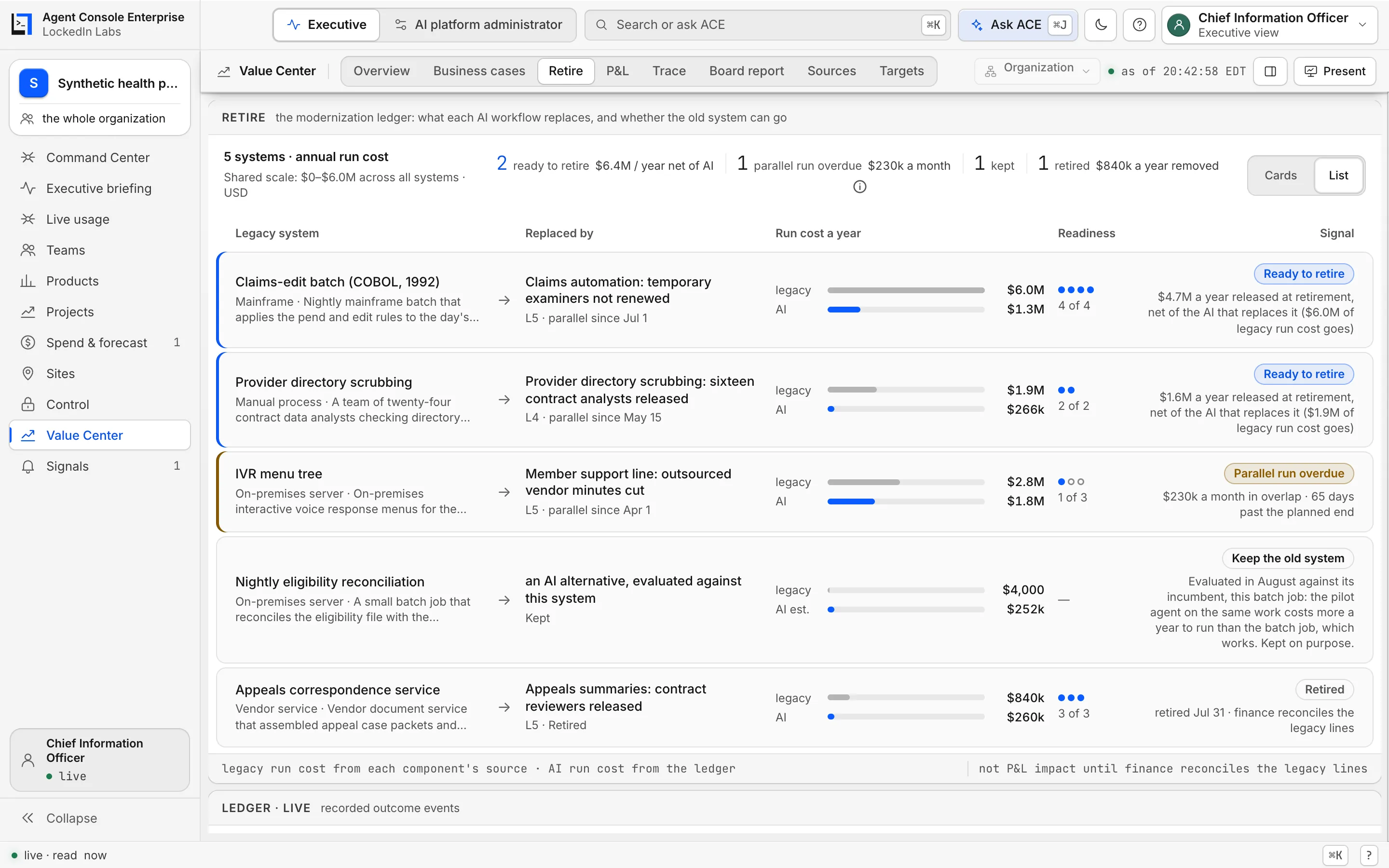
Synthetic modernization example · illustrative annual run rates
A new workflow replaces a legacy batch.
A legacy enrollment batch carries a $6.0 million annual run cost in the Agent Console demonstration. Its AI replacement is shown with a $1.3 million annual run cost. The difference is a $4.7 million potential annual run-rate reduction, before build investment, transition costs and costs that are not actually removed.
While both systems run in parallel, that difference is not realized savings. The review still needs readiness evidence, a retirement decision and financial support for the expense lines removed. A license cancellation or a released capacity commitment may establish one component; a retained support contract may leave another in place. These are synthetic product figures, not customer results.
Parallel operation may be the right choice when the replacement has not yet demonstrated readiness. The economic record should show the overlap and its reason. A planned retirement date creates a review point, not proof that the old cost has disappeared. Retaining the legacy system can also be the right decision if the replacement does not meet quality or operating requirements.
Make finance review practical.
A benefit record should be understandable without reconstructing the entire project. Keep the claim, amount, period, baseline, evidence source, owner and review state together. Separate forecast from observed outcome, and sponsor-reported contribution from confirmed financial value. If several initiatives contributed to the same result, identify the attribution method and prevent the same benefit being counted repeatedly.
FinOps unit economics guidance supports choosing metrics aligned with business goals. For this review, the metric should serve a concrete question: did cost per accepted case improve, did the organization absorb more demand, or did a specific expense cease? Those conclusions can coexist without becoming one interchangeable value total.
- Which benefit is being claimed, and what baseline supports it?
- Are the investment, operating cost and benefit periods comparable?
- What money event or operational evidence changed the claim’s status?
- Who confirmed it, and what remains provisional or outside scope?
Agent Console connects supported utilization, ownership, project, outcome and finance records for this conversation. Its management profit-and-loss views preserve source, status and period; they are management reports rather than GAAP financial statements.
The executive decision is whether to continue, improve, expand, retire or retain the work. A credible value story gives that decision an evidence trail, including useful outcomes that have not become realized savings and costs that remain after delivery.
Sources & further reading
Primary documentation reviewed October 2, 2026. Provider capabilities and pricing depend on the model, platform and configured service. Examples are illustrative.