Enterprise utilization
The token total is the beginning of the conversation.
A rising token count can mean useful adoption, expensive repetition or a change in what you can observe. The executive decision depends on which one it is.
Start with the reading, before the ranking.
When an enterprise starts using AI across engineering, operations and customer service, a single consumption total becomes attractive. It fits on a slide, moves every week and appears to show adoption. But a total can grow because more work is being completed, because the same work is being attempted repeatedly, or because a previously invisible source has become connected. These situations require different decisions.
Before comparing departments, establish what the reading contains. A coding client may report estimated usage from observed activity. A gateway may measure the requests passing through its configured endpoints. A provider bill establishes a charge under a contract. Each has a different scope. Adding them without identifying overlap can count the same activity twice; treating an absent collector as zero can turn a reporting gap into a performance claim.
This is a practical starting point for AI FinOps. The FinOps Foundation’s AI guidance identifies allocation and linking cost data to business outputs as distinct challenges. An executive report should therefore carry the source, observation period and coverage alongside the number.
Find the accountable work.
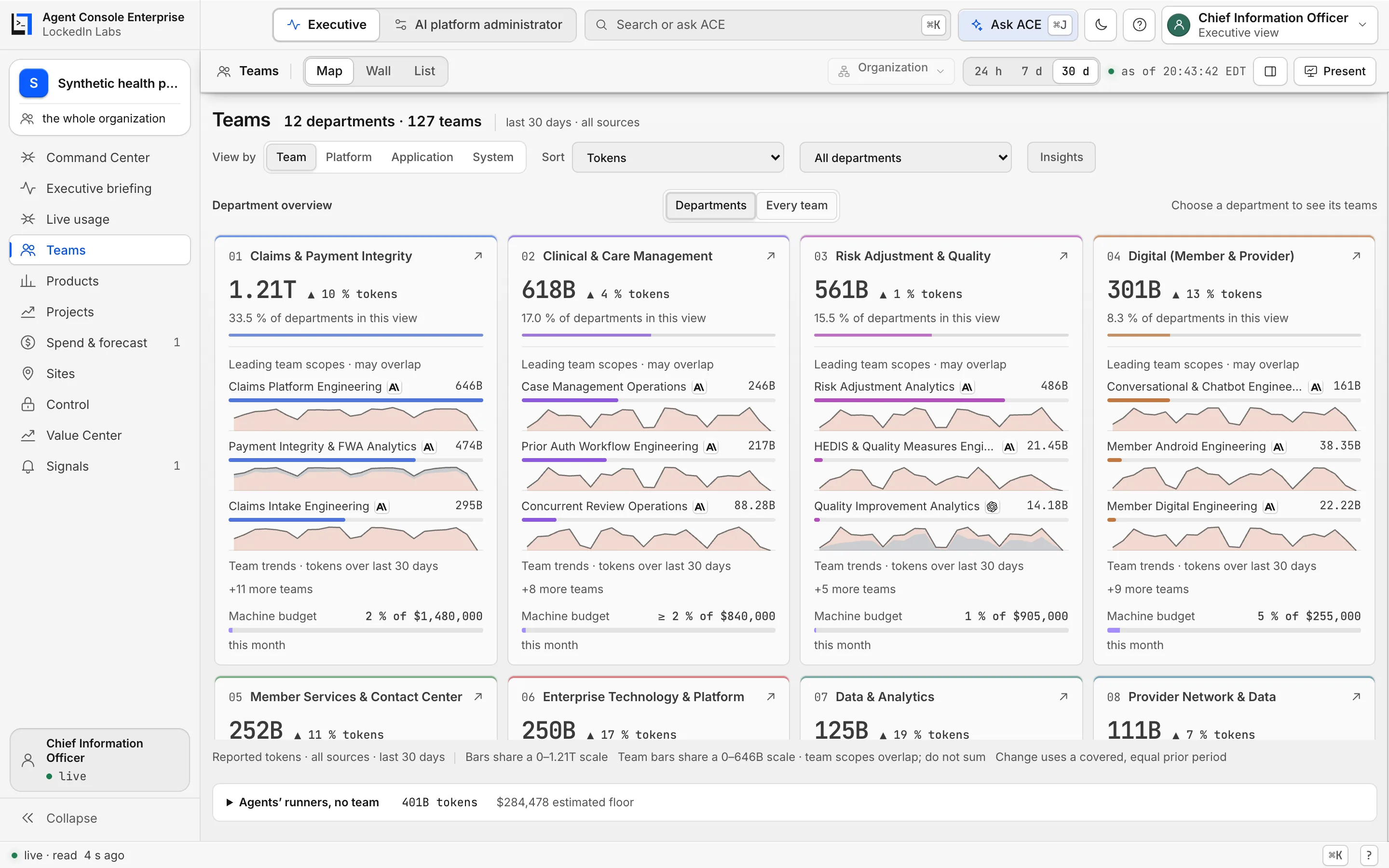
Ownership gives consumption a place in the operating model. The useful sequence is organization, department, team, product or platform, then project or workflow where the source supports that depth. Those dimensions answer different questions. A department explains budget responsibility; a platform explains a shared operating cost; a project explains the investment that introduced a capability.
Do not force precision where the evidence cannot support it. A shared API key can establish provider consumption without identifying the team that caused it. A team label can explain ownership without proving which project benefited. Keep unattributed activity visible and assign responsibility for improving its coverage. An honest unknown is more useful than an allocation that looks complete but cannot be reproduced.
Usage becomes decision evidence when its source, owner and purpose can be explained together.
The work itself also needs a denominator. For a support workflow, that might be cases resolved to the agreed standard. For an engineering workflow, it might be changes accepted after review. Define the unit before comparing periods. The FinOps unit economics capability distinguishes resource efficiency metrics from business unit metrics. Both are useful; they answer different operating questions.
Investigate a change before rewarding it.
Illustrative diagnostic · synthetic figures
Two teams. The same increase. Different explanations.
Imagine two engineering teams each reporting a 30% rise in observed tokens over a four-week period. Team A has released a document-processing feature, with higher completed volume and stable acceptance. Team B has started resending a long repository context after every failed attempt, while its accepted changes remain flat.
A utilization ranking presents both as stronger adoption. A workflow review finds a scaling decision for Team A and a context, retry or quality investigation for Team B. First check that both readings cover the same sources and weeks. Then examine task volume, model mix, repeated attempts and acceptance evidence. The percentages illustrate the diagnostic; they are not measured Agent Console performance.
The investigation should also account for timing. A project can incur heavy development consumption before it has operational output. A mature workflow can show lower tokens after an improvement while serving the same demand. Review similar stages and work types rather than treating every team as a contestant in one adoption table.
Make the next decision explicit.
A weekly operating review can start with a short set of questions that connect the reading to an action:
- Which sources and periods are included, and where did coverage change?
- Who owns the work, and what portion remains unassigned?
- Did accepted output, service quality or demand change with consumption?
- Does the evidence support expansion, an efficiency experiment or further observation?
Agent Console supports this conversation by relating available utilization and cost readings to organizational ownership and work context. Device estimates, workload measurements and provider billing retain their own basis. That makes the report useful without asking the reader to believe every token has an assigned financial return.
The goal is a reviewable choice about the next unit of investment. A high-consumption team may deserve more capacity. A low-consumption team may have a better process. The evidence behind the work determines which conclusion is defensible.
Sources & further reading
Primary documentation reviewed October 2, 2026. Provider capabilities and pricing depend on the model, platform and configured service. Examples are illustrative.